

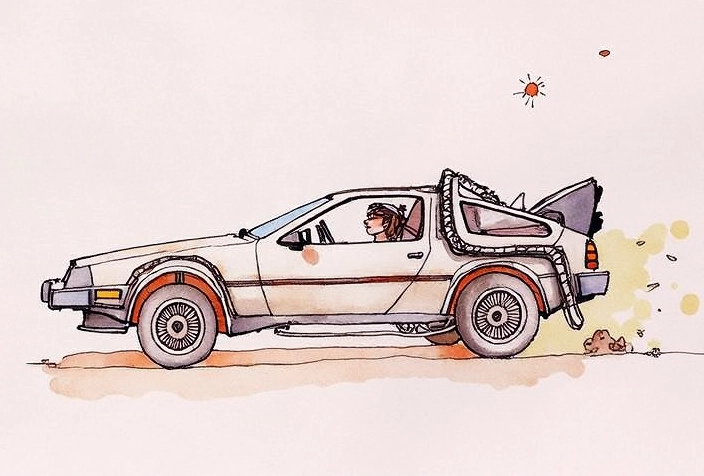
Today I’m going to create a few backstories for parts of famous movies that have always been left untold. Consider it a new fictional short stories series as I think I will have some fun with various movies. We’ll start with my favorite movie franchise of all: Back to the Future.
Jailbird Joey
Joey Baines grew up as the youngest of the Baines children, forever living in the shadow of his older siblings. Lorraine was the pretty one, the girl everyone noticed when she walked into a room. His brothers were athletes who collected trophies and praise with ease. Joey was different. He was outgoing, creative, and endlessly optimistic. He could tell a story that had everyone laughing, sketch cartoons on napkins that looked remarkably good, and convince almost anyone that his latest idea was destined to make him rich. The trouble was, Joey fell in love with dreams much faster than he fell in love with hard work.
As a boy, he was always scheming. He built a lemonade stand with flashing lights that cost more than he ever earned. He tried selling homemade comic books door to door. Once, he convinced himself he could train pigeons to race and spent months turning his bedroom into a makeshift aviary, much to his mother’s horror. Every failure was met with the same unwavering confidence.
“Just wait,” he’d tell Lorraine. “I’m gonna hit it big someday.”
Lorraine believed him for a while.
In the 1970s, Joey drifted from one opportunity to another. He sold miracle cleaning products from the trunk of his car, invested in dubious get-rich-quick schemes, and once printed fake backstage passes to a rock concert, insisting afterward that he had merely created “premium fan experiences.” He was never malicious. He simply wanted success badly enough that he ignored the warning signs everyone else could see.
Yet despite his endless mistakes, Joey remained impossible to dislike. He remembered birthdays, made his nieces and nephews laugh until they cried, and always showed up for family dinners carrying some ridiculous gadget or half-finished invention he swore would change the world. Lorraine often defended him when others rolled their eyes.
“Joey has a good heart,” she would say. “He’s just waiting for his luck to catch up with him.”
Unfortunately, luck never did.
In 1978, an old acquaintance approached Joey with what sounded like the opportunity he had been waiting for. The job was simple: transport a truckload of electronics across state lines for quick cash. No selling. No risk. Just driving.
Joey didn’t ask many questions. In truth, he didn’t want the answers.
For the first time in years, he allowed himself to imagine paying off his debts. Maybe buying a little house. Proving to his family that he wasn’t a failure.
The illusion shattered when state police pulled him over outside Indianapolis.
The truck wasn’t carrying ordinary electronics. The cargo consisted entirely of stolen stereos, televisions, and cassette decks linked to a burglary ring operating across three states.
Joey stood on the side of the highway, stunned, as officers unloaded box after box.
“I thought I was delivering stereos,” he protested weakly.
One of the officers closed his notebook and replied, “You were. Stolen stereos.”
The men who organized the scheme disappeared before charges were ever filed. Joey could have named names, but he never did. Partly out of misplaced loyalty, partly out of shame for being fooled so easily, and partly because, even then, he still believed they would come back and help him.
They never did.
The prison sentence broke something inside him. Not his humor, and not his kindness, but his certainty that life would eventually work out the way he imagined. Letters to his family became less frequent. The big plans disappeared. The dreams grew smaller.
Still, whenever Lorraine visited, Joey always put on a smile.
“Got a few ideas cooking,” he would tell her with a wink.
Lorraine always smiled back, even though she knew better.
Years later, when her children asked about Uncle Joey, she would pause for a moment before answering.
“We all make mistakes in life, children,” she would say softly. “The important thing is to remember that one bad decision doesn’t make you a bad person.”
And though Joey Baines spent much of his life behind bars, Lorraine never stopped believing that somewhere beneath the bad luck and foolish choices was the sweet, hopeful little brother she had always loved.
The Twin Pines Incident
The incident at Twin Pines Mall was initially treated as an act of terrorism. Local police responding to reports of gunfire found an abandoned van, multiple shell casings, and perhaps most troubling of all, a section of scorched asphalt where something extraordinary appeared to have occurred. Witnesses described a brilliant flash of white light so intense it left temporary blindness and a shockwave that shattered windows nearly a hundred yards away. At the center of the blast site, investigators found no wreckage, no bodies, and no trace of whatever had occupied the space that left Goodyear Radial marks, ash, soot, and char moments earlier.
The absence of evidence became the evidence.
Within hours, agents from the FBI arrived in Hill Valley. The scene was sealed off, then expanded again when military scientists detected unusual radiation signatures and microscopic changes to the molecular structure of the pavement that no one could explain. The official theory formed quickly: Libyan operatives had tested an experimental directed-energy weapon on American soil, completely vaporizing their intended target and leaving almost nothing behind.
The possibility sent shockwaves through Washington.
The surviving terrorists were captured less than forty-eight hours later after a nationwide manhunt. Exhausted and terrified, they insisted they had only pursued a man who had stolen something from them. Their explanations were incoherent. They spoke of plutonium, impossible technology, and a machine they barely understood. Federal interrogators dismissed the stories as deliberate misinformation designed to conceal Libya’s technological breakthrough.
The men were transferred to a maximum-security federal prison and held in complete isolation.
Meanwhile, the intelligence community spiraled into panic.
Satellite imagery of Libyan military sites was reexamined. Reconnaissance flights increased over North Africa. Classified reports warned that if Libya truly possessed a weapon capable of instantaneously disintegrating matter, the global balance of power could shift overnight. Congressional committees convened emergency sessions behind closed doors. Defense contractors received enormous new contracts to study directed-energy weapons and exotic physics.
And at the center of it all sat a perplexed President Ronald Reagan.
Late one evening in the Oval Office, Reagan held a secure telephone receiver while aides and intelligence officials watched silently from the edges of the room. On the other end of the line was Libyan leader Muammar Gaddafi.
The President dispensed with pleasantries. “We know what happened in California,” Reagan said evenly. “And if your government has developed this technology, we’re going to need to have a serious conversation.”
There was a pause. Then Gaddafi laughed. At first Reagan thought it was bravado. But the laughter continued, growing louder and more incredulous. Finally, Gaddafi spoke.
“You Americans have lost your minds. If I possessed such a weapon, do you think I would share it with the American military?”
The line went quiet. Because for the first time, Reagan considered an even more disturbing possibility. What if Libya didn’t know what had happened either? Normally, Gaddafi would brag about things like this, so Reagan didn’t think he was bluffing.
Years passed. Sanctions tightened. Intelligence agencies searched endlessly for proof of the mysterious weapon that had seemingly erased matter itself. Laboratories attempted to recreate the effect and failed repeatedly. Classified reports grew thicker while answers remained elusive.
Eventually the Twin Pines Incident became one of the Cold War’s strangest unsolved mysteries. Most of the files remained sealed. The surviving terrorists died in prison maintaining the same unbelievable story until the end: they had not destroyed a mysterious vehicle.
They had watched it disappear. And somewhere deep within a classified government archive lies a photograph that still unsettles everyone who sees it. Two parallel lines of fire and Goodyear radial tires scorched into the pavement. Beginning nowhere. And ending nowhere.
A Fatal Train Crash and the Hill Valley Decision to Name Eastwood Ravine
From the Hill Valley Telegraph, Special Edition, October 1885
The citizens of Hill Valley continue to discuss the extraordinary and sorrowful events that transpired last month, culminating in the deaths of three of our town’s most curious residents.
Mr. Clint Eastwood, a mysterious drifter of few words and remarkable courage, first came to prominence when he intervened in a dispute with the notorious outlaw Buford “Mad Dog” Tannen. Though his origins remain uncertain, many townsfolk believed Mr. Eastwood to be a man of honor, if somewhat peculiar in his manner and speech. His close association with the eccentric inventor Dr. Emmett Brown and the respected schoolteacher Miss Clara Clayton only deepened the mystery surrounding him.
Dr. Brown, long regarded as Hill Valley’s most brilliant yet unconventional blacksmith, had spent his short time here talking about strange experiments and mechanical contrivances he was building that few could comprehend. Miss Clayton, whose intelligence and grace endeared her to the town, had recently become engaged to Dr. Brown. Their future together appeared bright, though many remarked that Dr. Brown often seemed haunted by concerns he could not fully explain.
Following a humiliating defeat at the hands of Mr. Eastwood, Buford Tannen vanished from public life. Some believed the outlaw intended revenge, while others claimed he fled the territory entirely in disgrace. Whatever the truth, it is widely believed that fear of Tannen’s wrath played a role in the desperate actions that followed.
On the evening of September 7th, witnesses reported seeing Dr. Brown, Miss Clayton, and Mr. Eastwood commandeer a locomotive from the railroad yard and race eastward at tremendous speed. Townspeople watched in disbelief as the engine thundered away, with some claiming they saw armed riders in pursuit, though these reports remain unconfirmed.
Tragically, it appears the fugitives either did not know, or forgot in their haste, that the railroad tracks had not yet been completed. Search parties later discovered wreckage scattered throughout the ravine below. The force of the crash was said to be so catastrophic that no trace of the locomotive’s occupants could be found. Not a body, not a keepsake, not even the remnants of their clothing were ever recovered.
The mystery of their intentions has become the subject of endless speculation. Some believe they sought to flee the territory and begin anew elsewhere. Others insist Dr. Brown had uncovered secrets that placed them all in danger. Still others suggest the trio shared a bond so deep that they preferred death together to a life lived in fear of Mad Dog Tannen.
Whatever the truth, their story has already become legend.
In the days following the tragedy, it became increasingly apparent that Buford Tannen would never again show his face in Hill Valley. At a town meeting held shortly thereafter, Mayor Hubert announced that the ravine east of Hill Valley where the locomotive met its fate would henceforth be known as Eastwood Ravine, in honor of the brave young man whose courage rid the town of one of the West’s most feared outlaws.
The declaration was met with unanimous approval.
As for the Tannen family, while Buford himself vanished into obscurity, his only son remains in the area which is a connection to Hill Valley that may draw Buford back some day. Time may soften old grudges, though some of the older residents still wonder whether the shadow of Mad Dog Tannen will ever truly disappear from Hill Valley.
Thus ends one of the strangest and saddest chapters in our town’s history, a tale of courage, mystery, love, and loss whose secrets may never be fully known.