

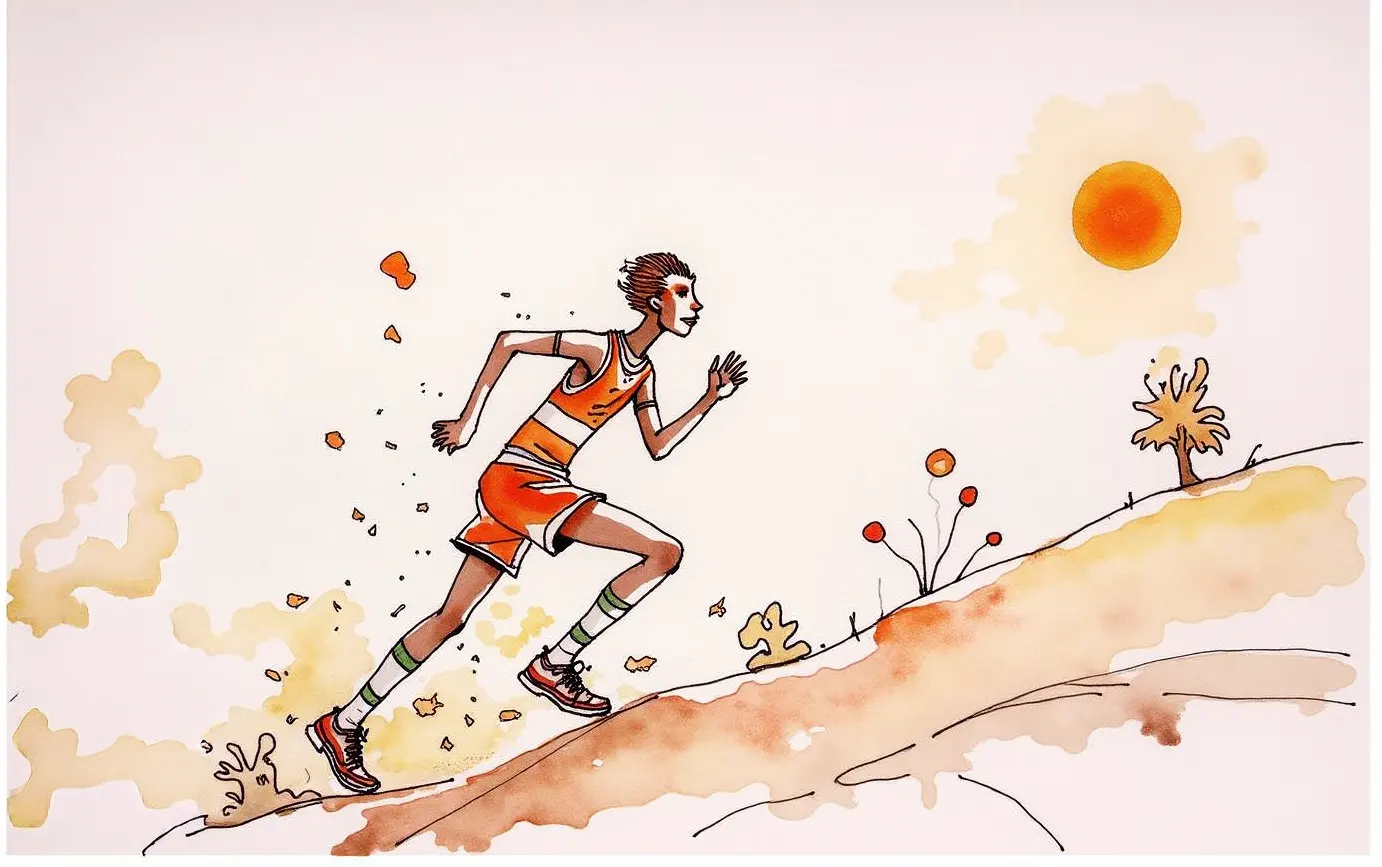
Early in my high school cross-country career, our second race of the season landed on a brutally hot day at a hilly, rural course near Lisbon, ND. I was still new enough to the sport, probably in 8th or 9th grade, and I hadn’t yet learned the unglamorous discipline of regular hydration. In those days, my idea of “fluids” was about half a case of Mountain Dew a day—and, if I’m being honest, I’d already been introduced to partaking in alcohol excess a bit earlier than I should have, because that was just the culture where I grew up (not a great excuse).
I remembered the start of that race clearly. I remembered the hills. I remembered the heat. And I remember something that didn’t make sense at all: shivering. Full-body chills, even though it was blazing hot. That detail stuck with me, though I didn’t understand it at the time.
What I never have remembered is finishing the race.
The next clear memory I have is being on the bus afterward. I was confused and disoriented, trying to piece together how I’d gotten there. Apparently, I had finished the race, followed the course markings (usually a spray painted line), crossed the finish line, and walked back with the rest of the team—all while effectively blacked out. I was conscious and functioning, but my brain wasn’t recording anything. The tape was running, but nothing was being saved.
Here’s the science behind it. Severe dehydration compromises the body’s ability to regulate core temperature. Blood pressure can drop, electrolytes can go out of balance, and circulation to the extremities becomes less efficient. Shivering, in that context, is a protective reflex—your muscles firing involuntarily to generate heat when your system is already under stress. Add in reduced blood flow and poor cellular nourishment, and things start to go sideways fast. Source: GoodRx
The memory loss is another piece of the puzzle. What I experienced wasn’t unconsciousness, but an inability to form new memories—similar to alcohol-induced blackouts. That distinction matters, because causes like this exist on a spectrum: from temporary circulatory and neurological stress to catastrophic system failure. Source: Temporary Memory Loss during Dehydration
I got very lucky.
Sometimes these stories end much darker. A sobering example is Korey Stringer, an offensive tackle for the Minnesota Vikings, who died at age 27 on August 1, 2001, after collapsing from heatstroke during training camp in Mankato. Extreme heat, dehydration, and inadequate on-field treatment turned a routine practice into a fatal event.
That race taught me—painfully early—that the body keeps score whether you’re paying attention or not. Sometimes it gives you a warning. Sometimes it doesn’t. Ever get to the point of chills is a time to stop what you’re doing and hydrate immediately. I pushed too far and fortunately I’m here to tell the story about it. I think that’s my closest brush with severe injury or worse. I became the example the coach would give in his early season speeches about hydration and I wonder if I continued to be that for the years after I graduated.