

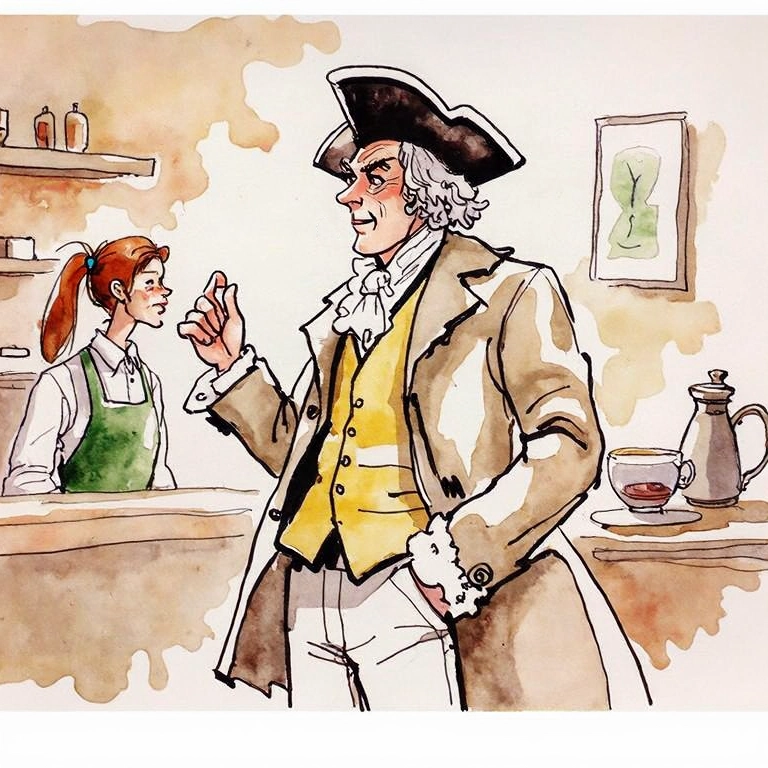
The man appeared on a Tuesday. Not in a puff of smoke or crack of thunder—just appeared—standing bewildered in the middle of a suburban intersection in Minneapolis, wearing a tricorn hat, waistcoat, and boots so polished they could shame a mirror.
Cars screeched. Horns blared. Someone yelled, “Nice costume, bro!” before the light turned green again and the chaos resumed.
The traveler, one Edmund Whitby, Esquire, blinked at the roaring machines rushing past. “Merciful heavens,” he muttered, gripping his brass pocket watch like a talisman. “The world has gone mad.”
He’d intended to leap only fifty years ahead—to see if his theories on temporal displacement might earn him a footnote in some future scholar’s journal. Instead, he’d overshot by nearly three centuries. The air itself buzzed with invisible energy. He could feel it thrumming in his bones, like a symphony of lightning.
Within the hour, he’d wandered into a coffee shop—partly for shelter, partly because the smell of roasted beans reminded him faintly of his old study. The barista, a young woman with blue hair and an expression suggesting she’d seen everything, raised an eyebrow.
“Can I help you, uh… sir?”
Edmund bowed stiffly. “Indeed, madam. Might I trouble you for a cup of—what is that marvelous aroma?”
“Coffee?” she said, already half-grinning.
“Splendid! One cup, please.”
“Size?”
He frowned. “Normal size?”
“Tall, grande, or venti?”
Edmund looked pained. “I fear your tongue has been most grievously altered by time.”
When the drink arrived, he sipped, eyes widening in reverence. “Ambrosia,” he whispered. “This alone justifies civilization’s endurance.”
The barista laughed. “You’re weird, but I like you.”
Over the next few hours, Edmund watched the people of 2025 with awe. Men and women communed through glowing rectangles, carriages drove themselves, and knowledge—once hoarded in libraries guarded by dust and silence—was now conjured with a few taps of a screen.
He saw wonders that made his 18th-century imagination ache: doctors curing ailments that once spelled death, ordinary citizens speaking freely across continents, music and art conjured in midair.
And yet… he noticed something else. Faces lit by screens but dulled in spirit. Conversations cut short by notifications. A loneliness humming beneath the surface of convenience.
That night, Edmund returned to the quiet park where he first arrived. He took out his pocket watch, now faintly glowing with residual energy, and whispered to the ether:
“Your progress is magnificent… but do not forget to live in it.”
But then he thought of the young woman behind the counter at the coffee shop, her cheerful focus upon that steaming contraption—so like the blacksmiths and machinists of his own age, mastering flame and metal with care and providing him hospitality with a genuine smile. And that made him feel like there was still hope for this place, so he wrote a short note, popped back into the coffee shop and pinned it to the bulletin board.
“The future is brighter than I ever dreamed, but still warmed by your caring hands. Keep that flame, good lady.”
Then he turned the dial, vanished into the past.
The barista found it the next morning and smiled, knowing exactly which weirdo it was from.