

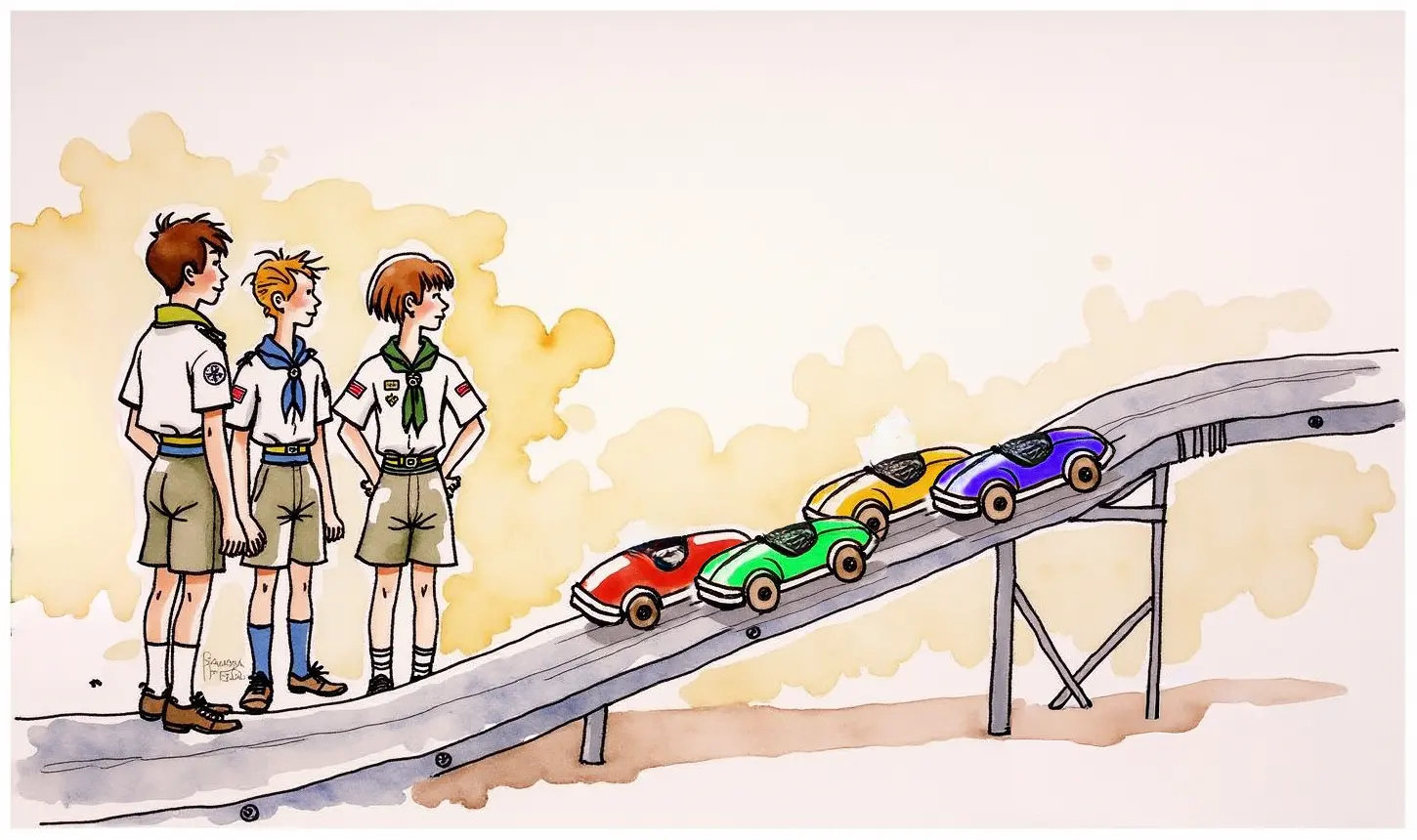
This past weekend was one of the busiest of the year: the Cub Scout Pinewood Derby. I’ve run about five or six of these—setting up the track, operating the timing system, and acting as master of ceremonies since I became Cubmaster a couple of years ago. Before that, I’d participated as a parent in three or four more. And once as a Scout when I was a kid, but that was traumatic in ways it shouldn’t have been. Cheating accusations after placing 2nd because, there’s no way Dustin could be good at anything…But back to modern day which is more important.
The whole operation is… chaotic. The software is ancient and buggy, the track is heavy and finicky, and the kids are rough on everything. Thankfully, there are other dedicated parents who help out—and this year, I didn’t have to worry about the banquet side at all.
Complicating matters, I was coming off one of the worst colds of my life. Each morning, it felt like razor blades were in my throat, which meant no enjoyment of my beloved morning coffee. I mostly tried to sleep it off, with Tylenol for aches and pains—but I skipped the typical cold medicines. I’ve noticed that whenever I chug DayQuil or similar stuff, my colds seem milder but more frequent, so I decided to just suffer through this one. My body has always been quirky like that—getting upset over anything from gluten and lactose to beans or even the mere presence of blooming sunflowers. (I still remember a high school cross-country practice where running past a sunflower field nearly knocked me out—I literally couldn’t breathe.)
But despite the chaos, the weekend turned out to be a pleasant surprise. After all these years, my kid finally won 1st place in the Pinewood Derby. Of course, that’s mostly a reflection of whether his parent can engineer a decent car. This year, I followed all the recommended steps: spent a bit more on a denser weight and placed it correctly, baked the wood to remove moisture, polished the axles and wheels, bent and twisted the axles with precision, and applied graphite at just the right points.
In past years, I’ve always skipped one of these steps—sometimes because I was too busy setting up the derby itself, and other times because I intentionally tried to make a slow car so no kid would be in last place. Well, except for MY kid in this case, but I just taught him to look at it all in a positive way. Alas, I had done that to him a few too many times, he was getting used to just never having a good derby car because dad was too busy running the derby. I was determined this year, and felt it was time for him to have some glory. Then of course, this year, there was a Scout who was clearly upset with having the obviously slowest car, which reminded me that many Packs now create “slow car” awards like Best Fuel Mileage or Turtle Class.that results in people engineering the cars to be as slow as possible (but still able to cross the finish line). That’s a very convenient way to have no one seeming like the biggest loser, you know? Scouts is supposed to be a non-competitive thing but this is that one time of year where things get competitive.
So like I said, this year, I decided to go all in—for my kid’s sake. And it paid off. And the sad kid at least won the design award which was well-deserved and I totally saw that coming. Next year is my kid’s last year in Cub Scouts and he’ll be building his own car from start to finish. I’ve done my part… lol. I hope his older brother doesn’t mind, with most of his cars though I was really really trying…just never figured it out.
I’ve been listening to
Hawaiian music. Weird, right? The Cub Scout banquet had a Hawaiian theme, so I threw together a playlist full of Hawaiian and reggae vibes. I love that stuff, so I was basically giddy. Who doesn’t like a little Israel Kamakawiwoʻole? Of course, I mixed in Bob Marley, Jimmy Buffett, and UB40. Then I realized the Ween album The Mollusk—one of my favorites—fit perfectly. Any chance to introduce a new generation to Ween is a chance you have to take. I see you, SpongeBob SquarePants Movie.
I’ve been reading
Wikipedia pages on the history of Fort Snelling in Minnesota. Yeah, taking a break from the kindle and just diving into some Wikipedia rabbit holes which is a thing I love to do. So I somehow ended up going down one on the history of Fort Snelling in Minnesota. I’m not sure why I’ve never really looked into it before—it’s such a fixture here, right at the confluence of the Minnesota and Mississippi Rivers, at the heart of early Minneapolis considering Fort Snelling was here first to keep tabs on what was going on up in the wilderness up here. I drive up there for the cemetery, the Scouting headquarters, and other events, and I guess I just thought of it as “that old fort.” But reading its history, I realized it’s way more significant—and complicated—than I’d appreciated.
Fort Snelling was established in 1819 as a frontier military post, intended to assert U.S. presence in the Upper Midwest and control river traffic. Its strategic location made it central to westward expansion, trade, and later, military operations. During the Civil War, it was one of the first sites in the region to train Union soldiers, serving as a key recruitment and staging ground for Minnesota regiments.
But the fort’s history is far from all heroic. It’s directly connected to the infamous Dred Scott case. Scott was an enslaved Black man brought to Fort Snelling by his owner, a U.S. Army officer, during the 1830s. Because Minnesota was free territory under the Missouri Compromise, Scott argued he should be emancipated. Unfortunately, the Supreme Court’s 1857 Dred Scott decision ruled against him, entrenching slavery and inflaming tensions that led to the Civil War. It’s wild to think such a nationally pivotal legal battle had roots right here in Minnesota.
Fort Snelling also played a grim role in the treatment of Native Americans. After the Dakota War of 1862, the fort served as a holding site for captured Dakota people, many of whom were confined in harsh conditions before trials and, tragically, executions. Nearby Mankato was the site of the largest mass execution in U.S. history, where 38 Dakota men were hanged—a dark chapter in Minnesota’s history that is uncomfortable but crucial to remember.
So, while Fort Snelling today might seem like just an old military site or a scenic stop along the rivers, it’s layered with complex stories—of military service, legal battles that shaped the nation, and deep injustices toward enslaved people and Native Americans. Definitely not just a relic; it’s a place where you can feel the weight of history.
I’ve been watching
The first couple NASCAR races of the season. Always good to see my guy Chase Elliott putting together some promising early runs. Daytona, of course, was a snoozefest… until the very end. Heartbreaking, though—my driver finally grabs the lead on the last lap, and then, seconds later, it’s gone.
It’s funny—when I think back to all the races I’ve watched since the mid-’90s, it’s always the final laps that stick in my memory. Sure, the long haul matters, and the grind of the race is part of the fun, but honestly, someone could probably just record the whole thing and only watch the last ten laps.
You’d think drag racing would be the popular format—short, intense, all action—but maybe that’s exactly why it doesn’t have the mass appeal. It’s over too fast. Personally, my favorite racing will always be local short tracks. I loved the idea of bringing stage racing into NASCAR, like they do at those tracks, but most fans aren’t on board.
Growing up, I didn’t make it to many races in person; it was always this cool thing on TV. Now, I live ten minutes from a track that hosts solid events all summer—including an ARCA race. It’s wild how much more alive it feels when it’s right in your backyard.
Racing announcers really set the tone for a race—just like they do for NFL games or any major sporting event. Yet, somehow, the Olympics manage to consistently showcase announcers who sound like they’re narrating a slow-motion documentary about paint drying. I’ll never understand it. However I hear they are using Leigh Diffey who has recently been calling late season NASCAR Races and I think he’s great. Hearing a british voice calling NASCAR was weird at first but I totally get it. He built a career calling open wheel racing.
Right now, during the Fox broadcast portion of the NASCAR season, we get a trio that’s… interesting. Mike Joy is there—well past his prime and with just enough ego to fill the grandstands. Kevin Harvick? He’s fine, I guess. Never a fan of him when he drove, always seemed to be a jerk. And Clint Bowyer—a former driver who raced for Michael Waltrip—is basically a Mikey Waltrip announcer in disguise. Which, yes, is a diss. There’s too much repetition, too many “funny” catchphrases, and far too many antics and bits. Far too much dumb BS.
The racing world needs more Benny Parsons and fewer Mikey Waltrips behind the mic. Benny Parsons will always be my favorite racing announcer. Sadly, he passed away some years ago, but he struck the perfect balance of knowledge, humor, and insight as a former driver and NASCAR champion. That’s the kind of voice that makes you lean in, not check your phone.
So my quote of the week below will be by Benny Parsons, forever the gold standard of racing commentary.
Quote of the Week
“Gas fuels racecars, but BBQ fuels old race announcers.” –Benny Parsons, 1973 NASCAR champion and ESPN commentator from 1988-2006
