

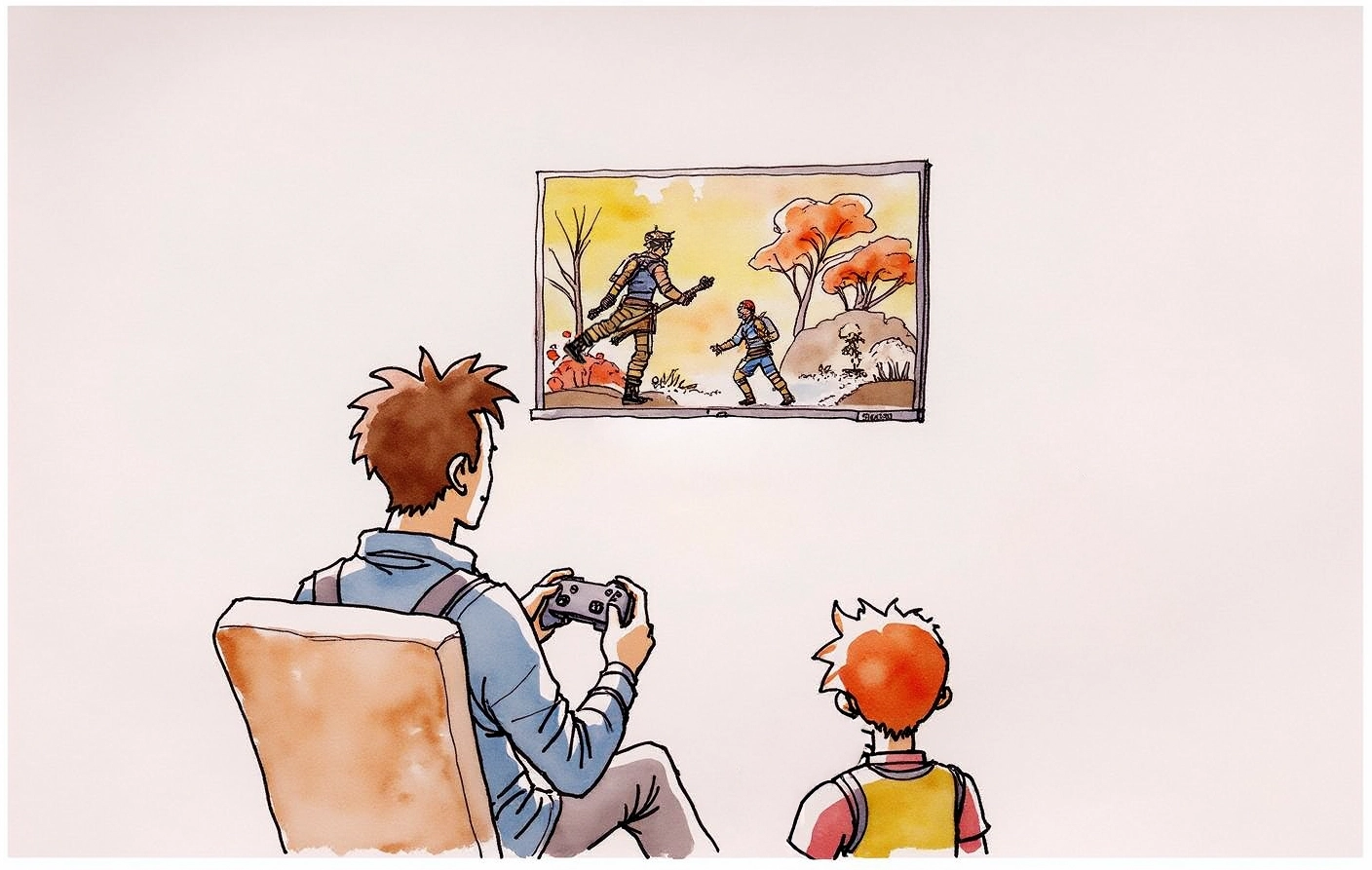
A few years ago, I tried Fortnite exactly once.
I say “tried” because “played” would imply some level of competence, strategy, or dignity. None of those things were present.
At the time, my son was around 12—prime age for believing parents are both ancient and deeply embarrassing. Fortnite was the game. It wasn’t just something he played; it was a culture, a language, a universe where he moved with confidence and purpose. I, on the other hand, moved like a confused tourist who that this was just a more colorful version of Call of Duty.
He thought it would be hilarious for me to try.
He was correct.
I have a bit of gaming history, which made this even funnier. Around the time my son was born, I played Call of Duty. Not professionally, not competitively—but enough to feel comfortable with a controller. I understood the basics: aim, shoot, move, survive. I had muscle memory. I had confidence.
Fortnite laughed gently at all of that and then threw it off a cliff.
Within moments, I realized this was not the world I remembered. In Call of Duty, the environment is mostly something you carefully move through. In Fortnite, the environment is something you are expected to create—rapidly, creatively, and under fire. While I was trying to remember which button crouched, other players were erecting five-star hotels out of raw materials they harvested seconds earlier.
Walls appeared. Ramps exploded into existence. Entire structures bloomed around me like aggressive origami.
Meanwhile, I was staring at the ground, accidentally swinging a pickaxe at a tree, wondering why everyone seemed so busy.
My son was crying laughing.
At some point, I decided the skydiving part was my strength. You jump out of a weird flying thing, fall through the sky, land somewhere—I was great at that, it seemed like the whole game! I would just get assassinated every time I landed is all. This, I told myself, was clearly the only thing I was good at in Fortnite.
It turns out I wasn’t even good at that.
I wasn’t skydiving to the right places. I wasn’t jumping at the right time. I was either leaping out way too early and drifting helplessly toward nowhere, or waiting too long and landing directly in areas already packed with people who immediately eliminated me. Apparently, even falling requires strategy now.
“Why did you jump there?” my son asked, between laughs.
I did not have an answer.
Then came the building.
“Build! Build!” he yelled, which is not helpful advice when you don’t know how to build or why you’re building or what you’re building against. I managed to place a single wall—facing the wrong direction—just in time to be eliminated by someone who clearly had a PhD in Fortnite architecture.
To be fair, everything takes practice and time to learn. Fortnite clearly rewards that investment. I just hadn’t made it. And after being openly shamed by a 10-year-old for “rage quitting” (a term he used with devastating accuracy), I decided that maybe this was not the game for me. I didn’t have the patience for that anymore.
I handed the controller back with the quiet dignity of someone who knows when they’ve been defeated on every possible level.
And that was it. One game. One memory. Forever.
Since then, my kids have repeatedly tried to lure me back into gaming—most persistently with Minecraft, which has somehow endured as the thing. They want me to play with them, build worlds together, create something meaningful.
I tell them I’ll watch.
Because I already spent years building Legos—carefully following instructions, sorting tiny pieces, constructing elaborate creations—only to have my firstborn disassemble them in roughly ten seconds flat the moment I proudly set them down. I’ve lived that life. I know how this ends.
As for Roblox, my firstborn got the full experience. He was there for it. But we’ve had to cut my youngest off entirely. The concerns over predators on the platform are real, the response by the people running it is not good enough, and that’s one place where nostalgia, fun, and “everyone else is doing it” don’t outweigh being cautious.
These days, my gaming life is much simpler and far less humiliating. I mostly play sports and racing games—things with clear rules, no sudden construction requirements, and minimal opportunities for my children to critique my life choices.
I’ve dipped into bigger worlds too. I played—and didn’t quite finish—several of the Assassin’s Creed games, though I got pretty deep into them. Valhalla especially pulled me in. I loved that world: the scale, the atmosphere, the feeling of just existing in it. Eventually, though, the bad guys started requiring more time, patience, and precision than I was willing to invest. I hit my limit and quietly walked away.
I played The Last of Us, which stuck with me, and I’ve always been loyal to Rockstar games. I played and finished both Red Dead Redemption titles, and honestly, those might be my favorite games of all time. I’ve also played and finished most of the GTA games—especially the most recent three—though I never really got into the online side of them. I preferred the stories, the worlds, and the ability to play at my own pace without being reminded by strangers that I’m not very good. But I am a beast at all forms of MarioKart of course and really enjoyed Breath of the Wild and need to tackle the new Zelda game one of these days.
Years later, Fortnite has come and gone for us, replaced by whatever the current obsession is. I know it’s still around but my kids don’t seem to be into it. Seeing my kids play these games makes me think about how games shape us—what they teach, and what we carry forward from them.
The games that shaped me were simpler on the surface. Mario. The Legend of Zelda. Double Dragon. Gran Turismo. You faced a challenge, failed, and tried again. You learned patterns. You built patience. Progress came from repetition and resilience, not from being the fastest or the flashiest. If something was too hard, you didn’t quit—you took a breath and gave it another shot, because that was the only way forward.
Those games quietly taught me how to deal with frustration, how to stick with something, how to accept failure as part of learning. You didn’t “rage quit.” You died, restarted, and figured it out.
Now I watch my kids navigate worlds that are bigger, louder, faster, and infinitely more connected. They learn different skills—creativity, collaboration, adaptability, speed. They build, strategize, and communicate in ways my childhood games never required. The lessons are still there, just delivered differently.
I don’t always understand their games. I don’t always jump out of the flying thing at the right time. But I do recognize the same core idea underneath it all: try, fail, learn, repeat.
And maybe that’s the real constant across generations—not the games themselves, but the way they teach us how to face challenges. Even if sometimes those challenges include being humbled by your own child, handing over the controller, and deciding that watching is perfectly okay.
Especially when you already know how this level ends.
One last thought: I often hear people say they don’t understand how kids can watch random people on YouTube play video games. I’d argue that Millennials and Gen Xers did essentially the same thing. We spent plenty of time at each other’s houses watching friends play, whether it was for entertainment or to pick up tips. If we wanted to learn specific skills or techniques, there were entire magazines dedicated to that—Nintendo Power comes to mind. Watching YouTube creators today is just the modern version of that same impulse. It’s how kids connect to the world of video games the same way we did, just through different channels.